
A recovery website built for clarity under pressure
How PulseCreate organised vehicle recovery, salvage, used parts and ten service areas into one consistent, mobile-first website.
The client
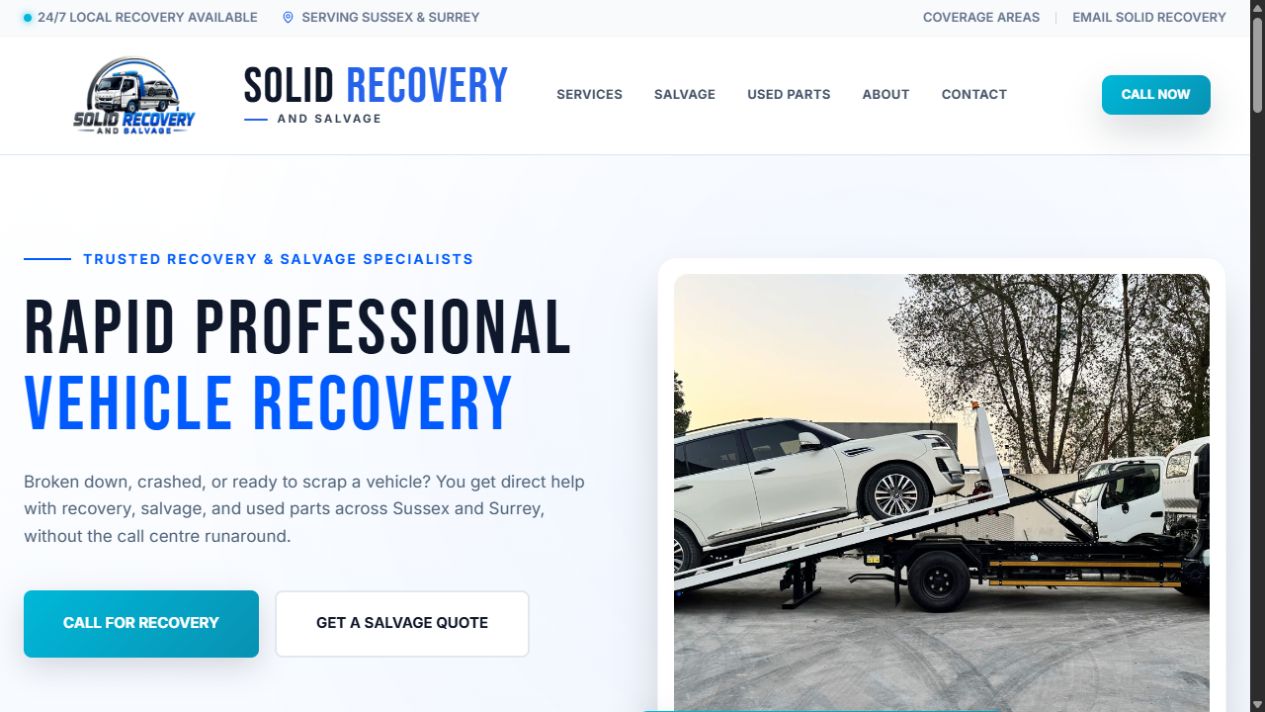
Solid Recovery & Salvage is an independent vehicle business covering recovery, salvage collection and used car parts across West Sussex, Surrey and the Gatwick area.
The same website has to work for people in very different situations: a stranded driver who needs a phone number immediately, an owner arranging vehicle salvage, and someone browsing for a specific used part.
The challenge
The content covered several services and a wide local area, but visitors needed a much simpler first decision: recovery, salvage or parts. The site also needed to feel consistent across every page while giving each service and location a useful, indexable destination.
The brief required a website that would:
- make the recovery phone route obvious on a small screen;
- separate recovery, salvage and parts without fragmenting the brand;
- explain the service area with useful local pages rather than one long place-name list;
- give every page a clear next action by phone, email or enquiry;
- load quickly and remain straightforward to host and maintain.
Because vehicle recovery is time-sensitive, visual polish had to support speed and comprehension rather than get in the way.
What we built
PulseCreate designed and built a responsive multi-page website with a shared component system and three unmistakable service routes.
The delivered site includes:
- Dedicated recovery, salvage and parts pages with distinct content and enquiry paths
- Ten local coverage pages for Horsham, Crawley, Gatwick, East Grinstead, Haywards Heath, Burgess Hill, Redhill, Reigate, Horley and Coulsdon
- Mobile-first navigation and calls to action for people arriving during an urgent situation
- A consistent visual system across service, area and contact pages
- Technical SEO foundations including clean URLs, unique metadata, canonical tags, structured data, robots.txt and an XML sitemap
The site is deliberately lightweight: semantic HTML, a focused CSS system and a small amount of JavaScript for navigation and interaction. That keeps the public pages fast, portable and independent of a page-builder subscription.
How the build was structured
The first step was information architecture. Recovery, salvage and parts became the three primary choices; area coverage and contact support those choices rather than competing with them.
Next, the visual language was unified across the whole site: the same header, footer, buttons, page rhythm, typography and service cues. Reusable styles make the pages feel like one business and reduce the chance of small inconsistencies appearing during future updates.
Before launch, the pages were checked at desktop and mobile sizes, contact routes were verified, and the sitemap URLs were tested. The final files were then packaged for the client’s hosting rather than tied to a proprietary platform.
The outcome
The website is live and in use today. Visitors can move directly to recovery, salvage or parts, see whether their location is covered and choose the most appropriate contact route.
No ranking or lead numbers are being claimed here without client analytics. The verifiable result is the live delivery itself: a coherent multi-page site with clear service journeys, local coverage and an implementation the client can host independently.
Why this matters for your business
Local service websites often have more complexity than their page count suggests. They must communicate urgency, explain several services, establish trust and cover a real geographic area without becoming repetitive.
This project shows how PulseCreate handles that problem end-to-end: content structure, responsive design, technical SEO, delivery and launch. If you are comparing approaches for a local business, see the dedicated Horsham web design service or the practical website brief.
Case study by Ryan Vessey — I designed, built and prepared the site for launch through PulseCreate. More about me and how I work →
Need a clearer local business website?
Standard websites are a fixed £1,495, and the process starts with a free homepage demo so you can judge the work before committing.